
Delivery is only one part of what happens when a strategy is put into action. The harder part is making sure the plan for change still makes sense once it meets the organisation’s people, habits, and history.
That’s especially true in environments where governance, information security, risk, and regulation set the terms for the work. They shape what can be done, how quickly it can move, and whether the change will hold. Treating them as administrative hurdles around delivery is one of the ways transformation effort fails.
My approach connects strategy, innovation programmes, delivery, assessment, and organisational improvement into a continuous loop. It’s been shaped by hands-on project work, collaboration with teams, and practical experience across delivery, governance, information security, research, and organisational change.
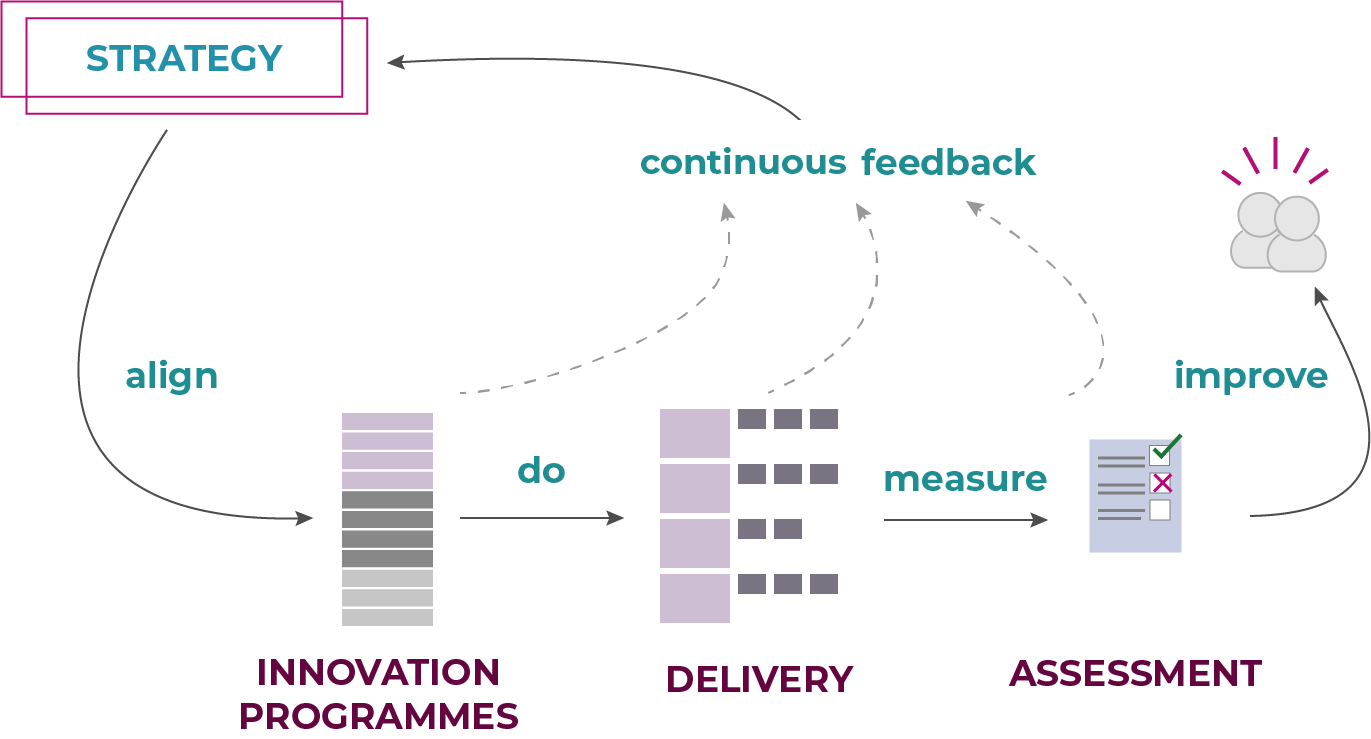
The aim is to keep transformation connected to clear outcomes, real people, and the gap between what was intended and what is actually happening on the ground. Used well, that gap is not a weakness to hide. It becomes evidence for better decisions, stronger delivery, and organisational learning.
Align
The first task is to understand what the strategy is really asking the organisation to do. That means looking beyond strategic catchphrases to the problem being addressed or the change being sought.
The goal is always to get into the real work, but the first step is to understand what is already happening across the organisation. That means looking at technology, operations, governance requirements, known constraints, and the informal ways people already get things done.
At this stage, I work with leadership and the teams most affected by the change to define meaningful measures of success. Done well, that gives people a clearer sense of what is expected, what is changing, and how progress will be understood.
The aim is to connect the right problem to feasible action, so later decisions about budget, priority, and progress are easier to make.
Do
Once the direction is clear, the work has to move from programme intent into delivery.
I work with existing teams to support discovery, planning, delivery, and implementation. Depending on the need, this can include service design, architecture, research, analysis, delivery support, testing, cloud platform considerations, automation, and the practical structures needed to turn strategy into working change.
But doing the work is not just a technical exercise.
The introduction of new technology, services, or ways of working almost always creates organisational change. People need to understand what’s changing, why it matters, how it affects them, and what they’re expected to do differently.
What helps or hinders the work might be communication, skills and training, governance, or complex dependencies that get lost without clear ownership. The point is to bring those factors into delivery early, so they can be dealt with as part of the work rather than discovered afterwards.
Where specialist expertise is needed, I can help shape the right approach and work effectively with internal teams, suppliers, or existing partners.
Constant feedback
Transformation shouldn’t rely on a big reveal at the end. By then, the useful information has usually arrived too late.
I work with organisations to create a constant feedback loop between strategy, programmes, delivery, and the people affected by the change. That includes the teams doing the work, the people expected to adopt it, and the customers, users, products, or services the organisation exists to support.
The point is not just to report progress. It is to keep strategy informed while the work is still moving.
Feedback from delivery should affect what gets delivered, when it gets delivered, what gets tested next, and whether the original problem is still the right one to solve. The next best step is not always more delivery. It might be a smaller experiment, a change in priority, or stopping work that no longer makes sense.
This is especially important in agile or complex delivery environments, where the work can look chaotic from the outside even when it is being managed well.
Constant feedback gives leadership enough evidence to make decisions while giving delivery teams enough room to respond to what they’re learning. It keeps the two connected by turning uncertainty into regular decisions about scope, timing, priority, and what should be tested next.
Measure
Measurement isn’t just about whether something was delivered.
A system can go live, a process can be changed, a team can be restructured, and still the intended outcome may not happen.
I help organisations assess whether change is having the effect it was meant to have. That means looking at the work during implementation, not just after it, and paying attention to how teams, systems, processes, responsibilities, and decision-making are responding.
It also means looking beyond internal activity to the purpose of the organisation itself: its customers, products, and services.
This can include delivery progress, adoption, operational impact, governance, cross-functional engagement, capability gaps, ownership, workload, customer or user experience, product performance, service quality, and whether people are actually able to work in the way the change requires.
The useful question is not just “did it happen?” but “what changed because it happened?”
Improve
Assessment should lead to improvement, not just reporting.
The point is not to produce another document that explains what everyone already suspects. The point is to help the organisation get better at changing.
That might mean improving governance, refining delivery practices, strengthening communication, clarifying ownership, adjusting how teams work together, or helping people build the skills and confidence they need to sustain the change over time.
Successful transformation requires more than delivery discipline. Leaders and teams also need business analysis, research, communication, judgement, and change leadership. They need to understand not just what is being delivered, but how it changes the work, who it affects, and what the organisation now needs to be able to do.
I have learned that capability is built in context. Generic training and certification have their place, but they are no substitute for learning through the real work.
I help identify gaps and address them in context, so people are left with practical knowledge they can use, not just a framework, a process, or a certificate.